

Businesses in 2026 need more than a good product or service to remain competitive. They need efficient processes, connected systems, better customer experiences, and faster access to important business information.
As companies grow, spreadsheets, manual tasks, and disconnected tools can create delays, errors, communication gaps, and unnecessary work. Software development helps businesses overcome these challenges by creating digital solutions that automate processes, connect systems, manage data, and support long-term growth.
With technologies such as artificial intelligence, cloud computing, automation, and data analytics becoming increasingly accessible, businesses have more opportunities to create smarter and scalable digital operations. The real question is not whether a business needs more technology, but whether the right technology can solve its existing business problems and create measurable value.
What Is Software Development?
Software development is the process of planning, designing, developing, testing, deploying, and maintaining software applications or systems. Businesses can use software for customer management, sales, inventory, finance, employee management, communication, analytics, automation, and internal operations.
A typical development process starts with requirement analysis and planning, followed by design, development, testing, deployment, and maintenance. The process begins by understanding the business requirement and identifying the problem that needs to be solved. Developers then design and build the solution, test its functionality and security, deploy it, and provide ongoing maintenance.
For businesses, software development is not simply about writing code. It is about creating a digital solution that solves a specific problem, improves operations, supports employees, and contributes to measurable business objectives.
The Business Landscape Has Changed in 2026
Customer expectations and business operations have changed significantly. Customers now expect faster communication, convenient digital services, and smooth online experiences. Employees also need tools that allow them to access information quickly and complete their tasks efficiently.
At the same time, businesses generate large amounts of data through sales, marketing, customer interactions, finance, and daily operations. This has increased the importance of automation, artificial intelligence, cloud computing, data analytics, system integration, cybersecurity, and scalable software.
Businesses that continue relying heavily on manual processes may find it difficult to maintain efficiency as they grow. Modern business software can help organizations create connected workflows, reduce repetitive work, organize information, and make better use of their data.
Where Traditional Business Processes Start Breaking Down
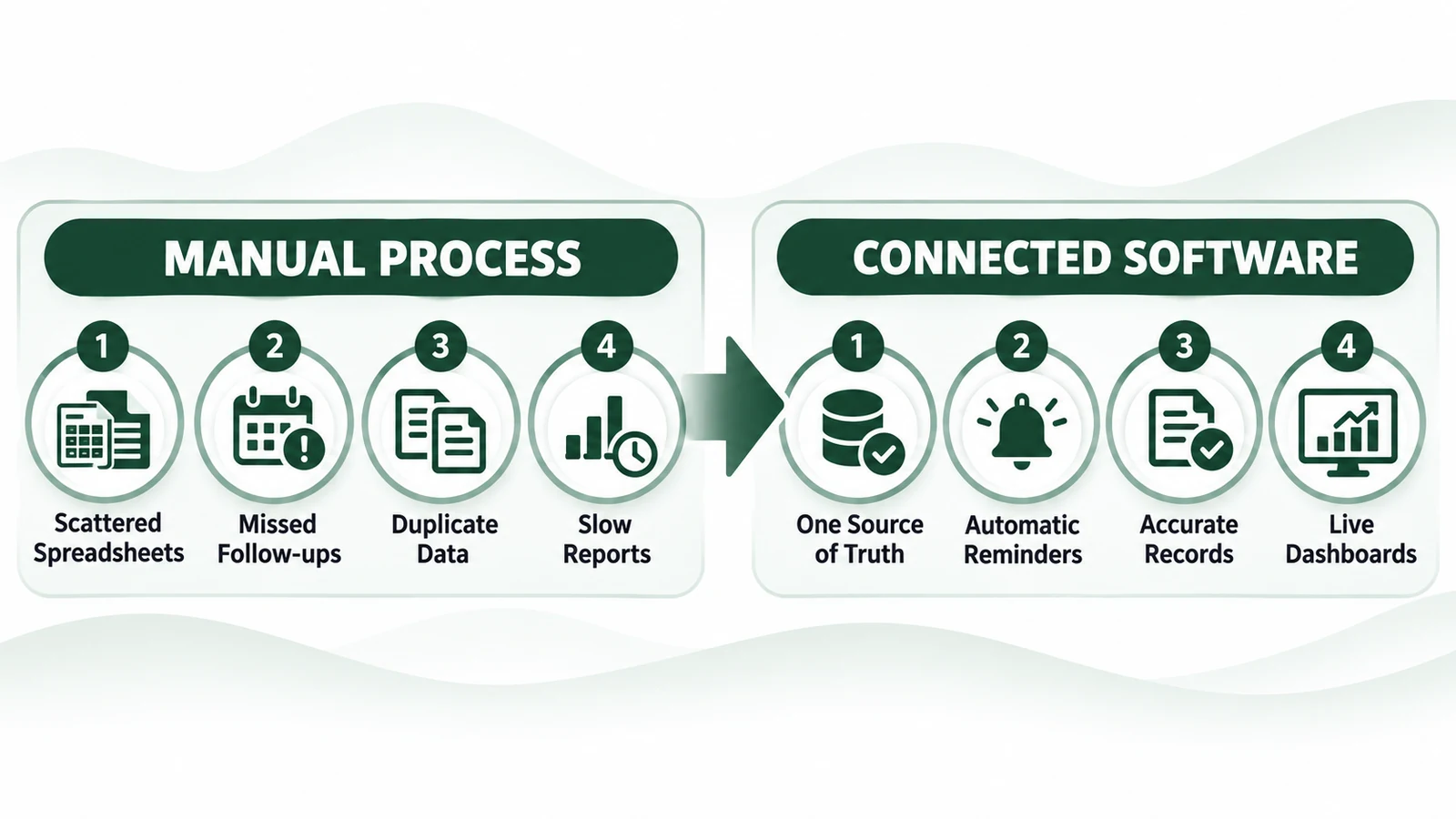
Manual processes can work well when a business is small. However, they can become difficult to manage when customer numbers, transactions, employees, and data increase.
For example, a company may manage customer enquiries through phone calls, WhatsApp, email, and spreadsheets. As enquiries increase, employees may struggle to track every lead and complete follow-ups on time. This can result in missed opportunities, duplicate records, data errors, delayed communication, and time-consuming reporting.
Similar challenges can occur in inventory management, finance, HR, customer support, and project management. Business process automation can convert repetitive manual activities into structured digital workflows. This allows employees to spend more time on activities that require human judgment, customer interaction, creativity, and expertise.
Types of Business Software
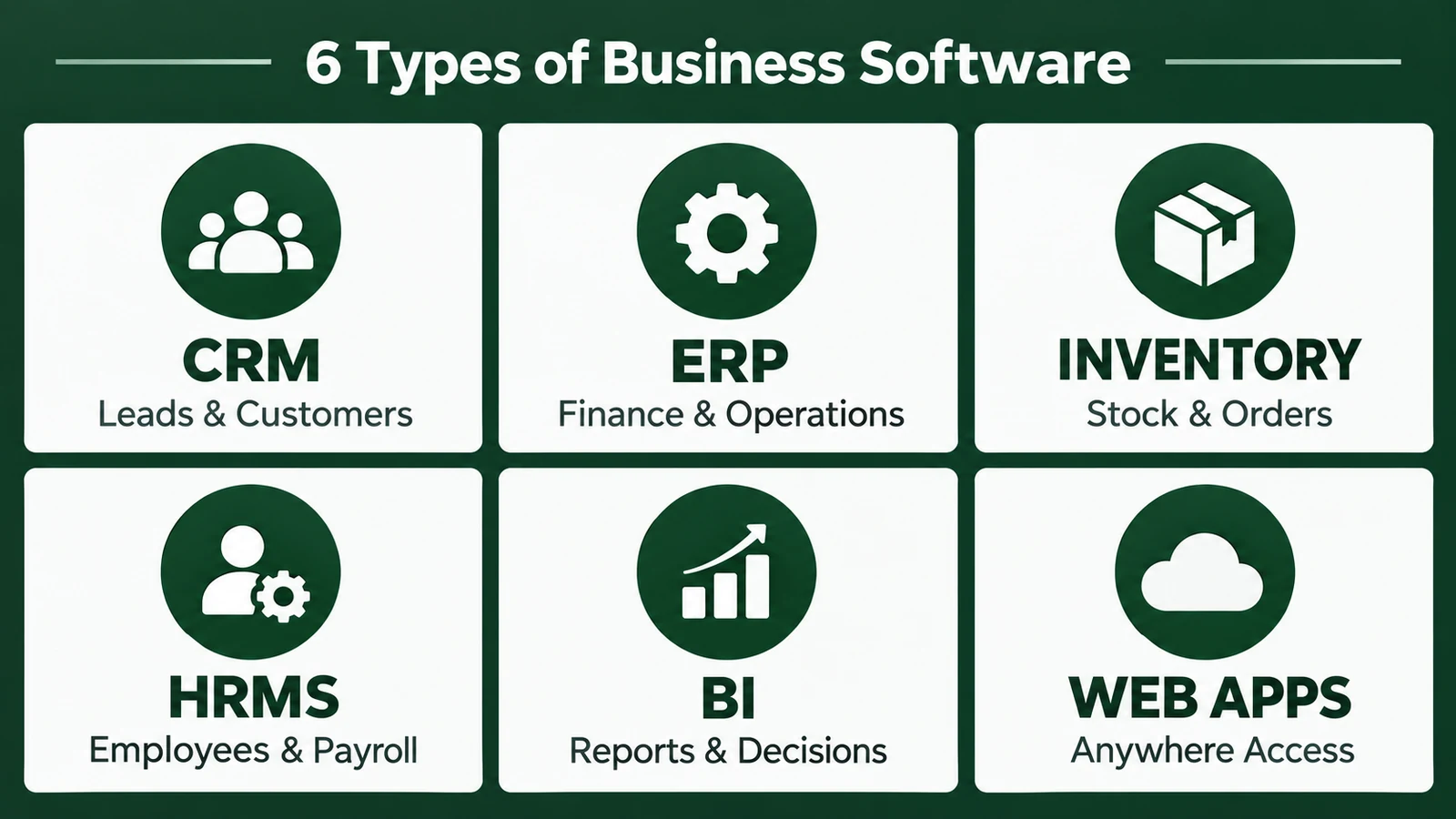
Businesses use different types of software depending on their operational requirements, industry, size, and growth objectives.
Customer Relationship Management Software
CRM software helps businesses manage leads, customer information, sales activities, communication, and follow-ups. A centralized CRM can give teams better visibility into customer interactions and sales pipelines. Instead of managing customer information across multiple spreadsheets or applications, employees can access important information from a centralized system.
Enterprise Resource Planning Software
ERP solutions can connect functions such as finance, inventory, procurement, sales, and operations. This gives businesses a more centralized view of their day-to-day activities and can help different departments work with consistent information.
Inventory Management Software
Inventory software helps businesses monitor stock levels, purchases, sales, suppliers, warehouses, and product movement. This can be particularly useful for retail, manufacturing, distribution, and e-commerce businesses where accurate inventory information is important for daily operations.
Human Resource Management Software
HR software can help organizations manage employee records, attendance, leave, payroll processes, recruitment, and other workforce activities. By digitizing these processes, HR teams can reduce repetitive administrative work and manage employee information more efficiently.
Business Intelligence Software
Business intelligence solutions convert business information into reports and dashboards. Managers can use these systems to understand business performance, monitor important metrics, identify trends, and make data-driven decisions.
Web Applications and Digital Platforms
Not every business needs software installed on individual computers. Web-based systems can provide customers and employees with access to business functionality through a browser.
For example, a business website can generate enquiries while a connected web application manages leads, customer information, bookings, or internal workflows. This is where website development and software development can work together to create a connected digital experience rather than functioning as completely separate systems.
Industry-Specific Software
Some businesses require specialized solutions designed around their particular workflows. Healthcare, logistics, education, manufacturing, real estate, and service-based businesses may have requirements that generic software cannot fully support.
In such cases, custom software development can provide greater flexibility because the solution can be designed around the organization's actual processes and requirements.
How Software Development Turns Business Problems Into Digital Solutions
A successful software project should begin with a business problem rather than a technology choice.
Consider a company where employees spend several hours every week preparing sales reports manually. Before developing a solution, the business should understand where the information comes from, why the process is manual, which systems contain the data, and what information management actually needs.
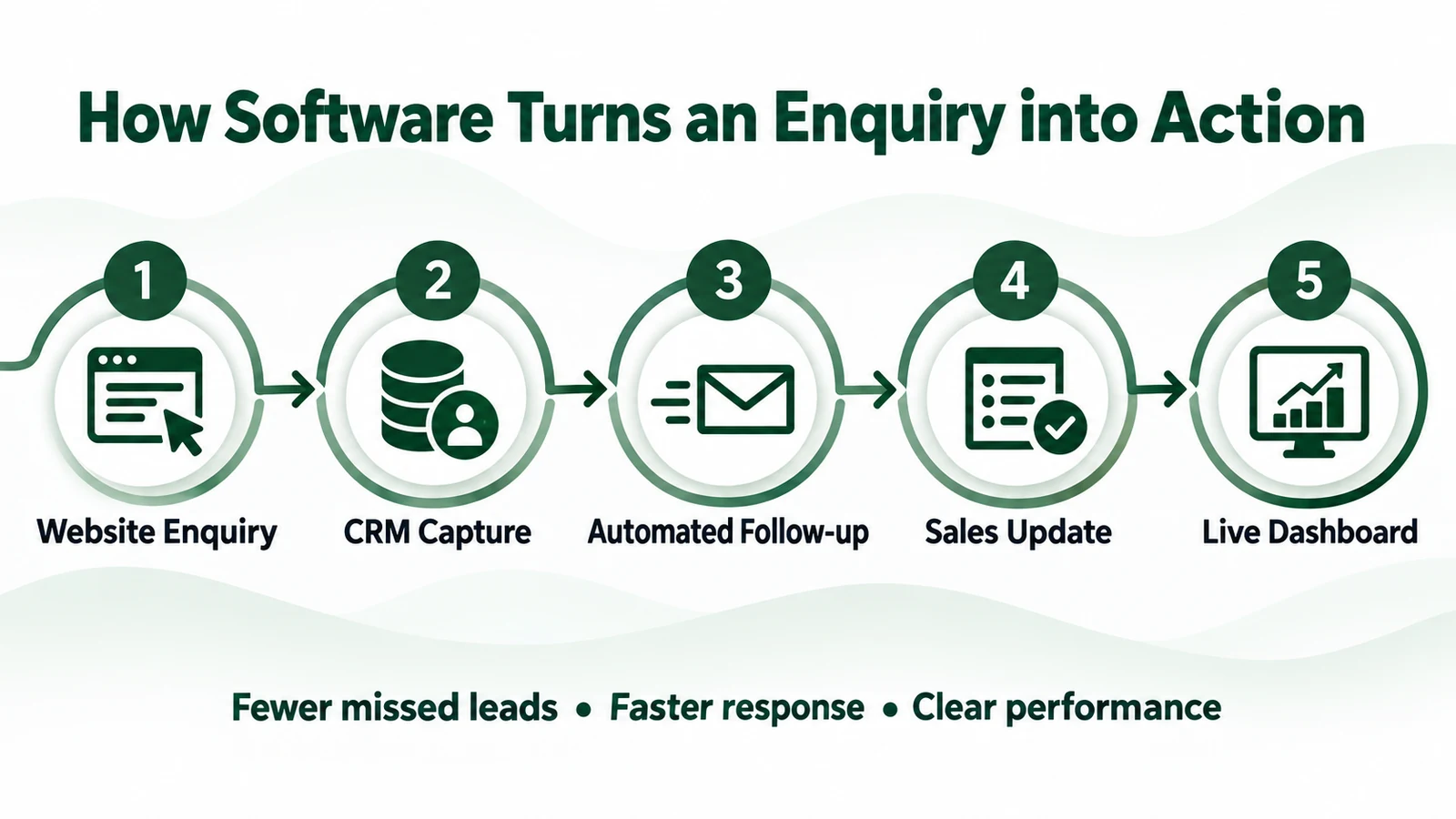
The final solution could connect the company's website, CRM, sales database, and reporting system. Instead of employees repeatedly collecting and organizing information, the workflow could become:
Website Enquiry → CRM → Automated Follow-Up → Sales Update → Dashboard
This type of connected workflow reduces repetitive work and makes important information easier to access. Employees can focus more on sales and customer relationships while management can monitor business performance through centralized information.
This is the real purpose of software development services: using technology to solve practical business problems and improve the way an organization operates.
7 Ways Software Development Can Improve Business Performance
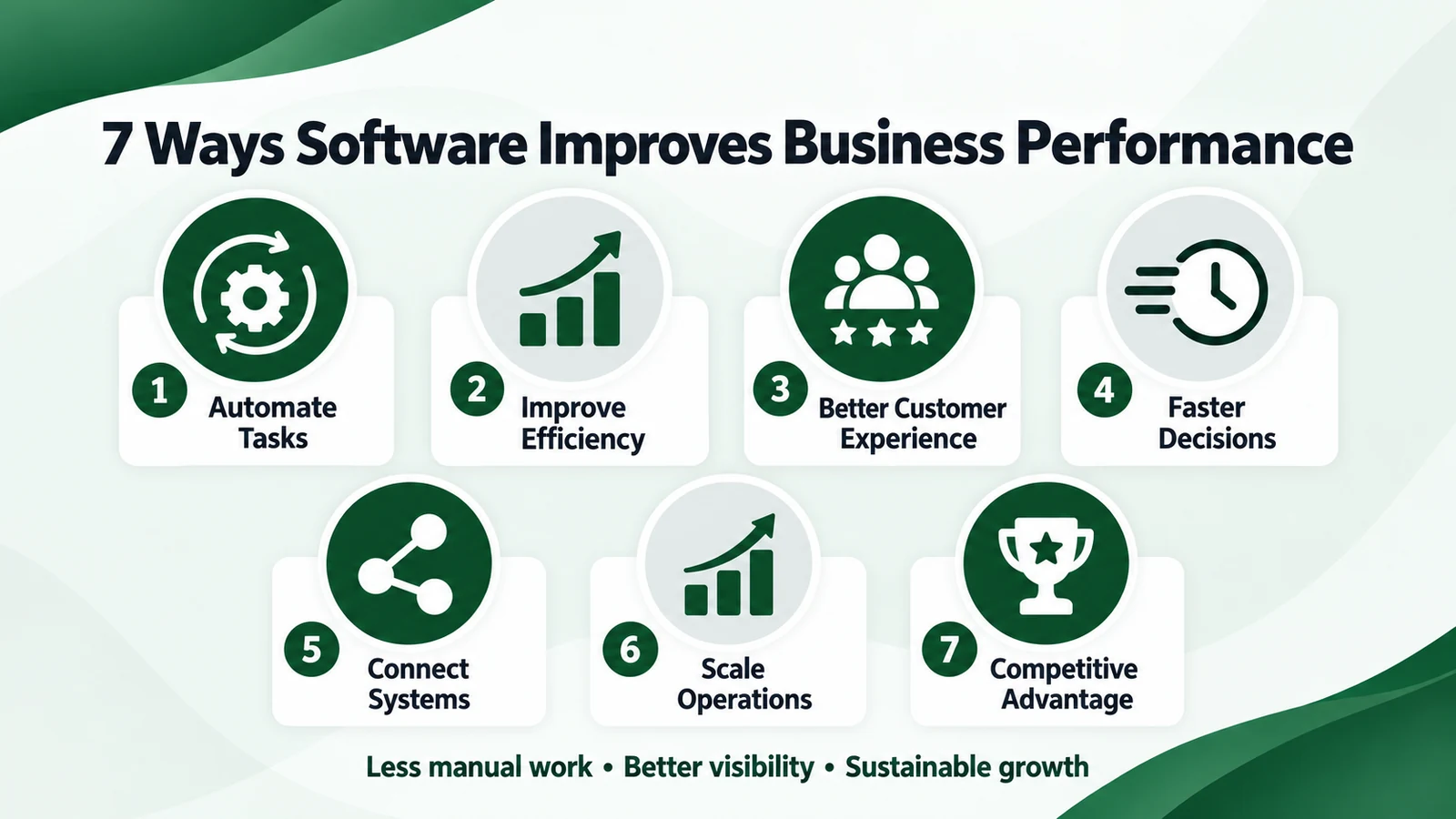
1. Automates Repetitive Tasks
Employees often spend valuable time on data entry, report preparation, invoice generation, notifications, and customer follow-ups. Software can automate many of these activities through predefined workflows, reducing repetitive work and allowing employees to focus on customer service, strategy, and problem-solving.
Automation can also improve consistency because predefined processes can be performed in the same way each time. This can reduce unnecessary manual effort and help businesses use their workforce more effectively.
2. Improves Operational Efficiency
When teams depend on multiple spreadsheets and disconnected tools, employees may spend unnecessary time searching for information or transferring data between systems.
A centralized software solution can organize important processes into structured workflows and make information easier to access. Instead of moving information manually between different systems, employees can work through a more connected process.
This can help businesses reduce delays, improve team coordination, minimize repetitive activities, and complete daily operations more efficiently.
3. Improves Customer Experience
Customers expect businesses to provide fast and convenient digital experiences. A well-designed website can help customers understand services, submit enquiries, make bookings, or purchase products.
More advanced software can support customer accounts, portals, automated notifications, and personalized interactions. When customer-facing platforms are connected with internal systems, businesses can respond faster and provide a smoother customer journey.
Website development therefore becomes an important part of the wider digital customer experience for many businesses.
4. Supports Better Decision-Making
Businesses generate data through sales, marketing, finance, customer interactions, and operations. However, data becomes valuable only when businesses can organize and understand it effectively.
Software can convert business information into dashboards and reports, helping managers understand sales performance, customer activity, revenue, inventory, and operational costs.
With better access to organized information, managers can identify trends, monitor performance, understand potential problems, and make more informed business decisions.
5. Connects Different Business Systems
Businesses often use separate platforms for marketing, sales, accounting, payments, and customer support. When these systems are disconnected, employees may need to transfer information manually.
Through APIs and software integration, different applications can communicate with each other. A connected workflow could look like:
Website → CRM → Payment System → Accounting → Analytics
This type of integration can reduce duplicate data entry and improve the flow of information across different departments. It can also help businesses create a more connected digital ecosystem.
6. Helps Businesses Scale
A process that works for a small company may become inefficient as the organization grows. More customers, employees, transactions, and data can make manual processes increasingly difficult to manage.
Scalable software can support increasing users, transactions, data, features, and integrations. Businesses can also expand their systems as their requirements change instead of completely replacing their technology.
This allows technology to grow alongside the business and provides a stronger foundation for future expansion.
7. Creates a Competitive Advantage
Businesses that use technology effectively can automate operations, respond to customers faster, and provide better digital experiences.
A strong website can support visibility and lead generation, while custom software can improve internal workflows and operational efficiency. When these digital capabilities work together, businesses can improve productivity, customer experience, and operational performance.
Technology therefore becomes more than an operational tool. It can become an important part of how a business differentiates itself from competitors.
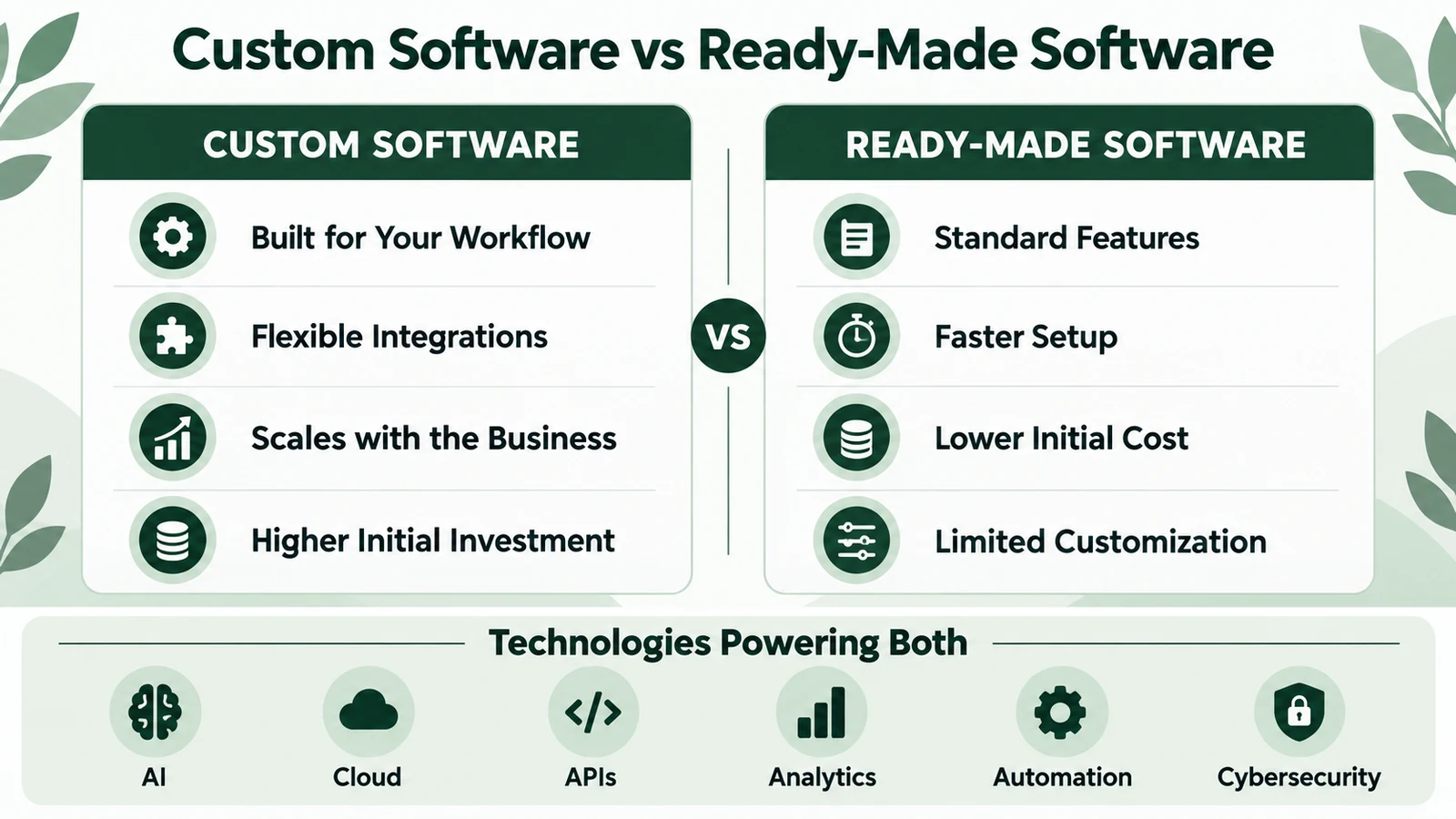
Custom Software vs Ready-Made Software: Which Is Better for Your Business?
Businesses generally have two choices when selecting software: ready-made software or custom software. The right option depends on the company's requirements, budget, processes, users, and future goals.
Ready-Made Software
Ready-made software is designed for a broad range of users and usually provides predefined features. It can be useful for businesses with standard requirements because implementation is generally faster and the initial investment may be lower.
Businesses can benefit from existing functionality and established support systems. However, they may need to adjust their processes to match the capabilities and limitations of the software.
Custom Software
Custom software is developed around the specific requirements of an organization. It can be designed according to business workflows, users, integrations, and future requirements.
Custom solutions can provide business-specific functionality, flexible workflows, custom integrations, greater scalability, and more control over the overall system.
However, custom development generally requires more planning, time, technical resources, and initial investment.
Which Should You Choose?
Ready-made software may be suitable when business requirements are standard and existing tools already provide the required functionality.
Custom software development may be more appropriate when a business has unique processes, specialized requirements, complex integrations, or long-term scalability needs.
The objective should not simply be to choose the most advanced technology. Businesses should select the solution that provides the most practical value and effectively solves their actual operational challenges.
The Technologies Making Business Software Smarter in 2026
Modern technologies are changing how businesses build and use software. Artificial intelligence, cloud computing, APIs, data analytics, automation, and cybersecurity are becoming important components of modern digital systems.
Artificial Intelligence
AI is becoming increasingly useful in business applications. Companies can use AI-powered solutions for customer support, data analysis, recommendations, document processing, workflow automation, and predictive insights.
AI can also support software development teams through coding assistance, testing, documentation, and maintenance. As AI technology continues to develop, businesses may find more opportunities to integrate intelligent capabilities into their existing workflows.
Cloud Computing
Cloud-based systems allow businesses to access applications and data through internet-connected environments. Cloud infrastructure can provide flexibility as business requirements change and can support organizations that need to manage increasing users and data.
Cloud-based solutions can also make it easier for employees to access business systems from different locations, depending on the organization's requirements and security policies.
APIs and System Integration
APIs allow different applications to exchange information. This makes it possible to connect websites, CRM systems, payment gateways, accounting platforms, analytics tools, and other business applications.
Integration can reduce manual data transfer and create more connected workflows across business operations.
Data Analytics
Analytics can help businesses understand patterns in sales, customers, marketing, and operations. Modern software can convert large amounts of business data into useful information for decision-making.
When businesses can understand their data more effectively, they can identify opportunities, monitor performance, and respond to changing business conditions.
Automation
Automation can reduce repetitive manual activities and improve consistency across business processes. Automated workflows can help businesses manage notifications, lead follow-ups, reports, approvals, data processing, and other routine activities.
Cybersecurity
As businesses become increasingly dependent on digital systems, security becomes an essential part of software development. Security should be considered during planning, development, testing, deployment, and maintenance.
Protecting business information, customer data, user accounts, and connected systems is important for maintaining trust and operational continuity. Businesses planning secure development practices can also refer to the NIST Secure Software Development Framework.
A Simple Example: From Manual Business to Digital Business
Consider a service-based company that receives customer enquiries through phone calls and messaging platforms.
Before software development, the process might look like:
Customer Enquiry → Employee Notes → Spreadsheet → Manual Follow-Up → Monthly Report
This process can become difficult to manage when enquiry volume increases. Employees may forget follow-ups, information may be entered incorrectly, and management may have limited visibility into lead performance.
After software development, the workflow could become:
Website Form → Automatic Lead Capture → CRM → Sales Assignment → Follow-Up Reminder → Dashboard
The company can now monitor leads, follow-ups, lead sources, and conversions through a centralized system.
The website handles the customer-facing experience, while the connected software manages the business process behind it. This demonstrates how website development, software development, CRM, and automation can work together to support business growth.
How to Know If Your Business Needs Custom Software
Not every business needs custom software. However, it may be worth considering when existing tools are no longer able to support the organization's requirements effectively.
Businesses may need to evaluate custom software when they have too many manual processes, multiple spreadsheets, repeated data entry, disconnected applications, missed customer follow-ups, time-consuming reporting, increasing operational errors, integration limitations, or difficulty scaling existing systems.
Another important consideration is whether the business has unique workflows that cannot be easily handled by ready-made applications.
A useful question to ask is:
Are our current tools helping the business operate efficiently, or are we changing our processes to work around their limitations?
If the second situation sounds familiar, it may be time to evaluate a custom software solution.
What Businesses Should Consider Before Developing Software
Before starting a software project, businesses should clearly understand what they want to achieve. The first step is to define the specific business problem the software should solve and identify the expected outcome.
Businesses should also understand who will use the system and what each user needs. Different users may require different levels of access and functionality, so understanding user requirements before development can help create a more practical solution.
The business should then identify the core features required for the first version. It is often better to focus on essential functionality before adding unnecessary features.
Integration requirements are also important. If the new software needs to connect with existing CRM, accounting, payment, marketing, or other business applications, these requirements should be identified during the planning stage.
Security should be considered throughout the entire development process. User accounts, business information, customer data, and connected systems need appropriate security measures.
Scalability should also be considered because the software may need to support more users, data, features, and integrations as the company grows.
Technology selection is another important part of planning. The technology stack should support the project's performance, security, scalability, and maintenance requirements.
Software development cost depends on project complexity, features, technology, integrations, development time, testing, infrastructure, and maintenance. Businesses should therefore define their requirements clearly before estimating the overall investment.
Finally, businesses should plan for ongoing maintenance. Software requires updates, security improvements, bug fixes, monitoring, and technical support after launch.
How to Measure the ROI of Software Development
Software investment should create measurable business value. A simple ROI formula is:
ROI = (Business Benefits − Software Investment) ÷ Software Investment × 100
Businesses can measure the impact of software by comparing important performance indicators before and after implementation. These may include time saved, cost reduction, revenue growth, conversion rate, customer retention, error reduction, employee productivity, processing time, and customer satisfaction.
For example, if an automated workflow saves hundreds of employee hours every month, those saved hours can be converted into measurable business value. Similarly, faster lead follow-ups may improve conversion rates, while automated reporting can reduce the time managers spend preparing business reports.
Businesses should define relevant KPIs before development and compare performance after implementation. This makes it easier to understand whether the software is delivering the expected return on investment.
What Is the Future of Software Development for Businesses?
The future of business software is moving toward systems that are more intelligent, connected, automated, and adaptable.
The combination of Software + AI + Cloud + Automation + Data will continue to influence how businesses build and use digital systems.
AI-powered applications can support intelligent workflows and data analysis, while cloud platforms provide flexible infrastructure and APIs allow different systems to communicate.
At the same time, businesses will need to pay greater attention to security, scalability, data protection, and responsible technology adoption.
The future is not simply about developing more applications. It is about developing software that continuously creates measurable business value and helps organizations operate more intelligently.
Why Choose ECOG Core Technologies for Software Development?
Choosing the right technology partner is important because successful digital transformation requires more than simply developing software.
ECOG Core Technologies works across different technology requirements, including software development, website development, Zoho consulting, digital marketing, and IT infrastructure. This allows businesses to address different technology requirements through a more connected approach.
For businesses that need a customer-facing digital presence, ECOG provides website development for corporate websites, business websites, e-commerce websites, landing pages, portfolio websites, and custom web applications.
For operational requirements, software solutions can include CRM, HR management systems, ERP solutions, workflow automation, and custom business applications. These solutions can help businesses streamline processes, organize information, improve communication, and gain better operational visibility.
ECOG's approach covers important stages such as discovery and planning, UI/UX, development, testing, launch, and ongoing support. A structured process helps businesses move from an initial requirement to a practical digital solution.
Whether a business needs a new website, a custom application, workflow automation, or connected business systems, the focus should always be on selecting technology that supports actual business objectives.
For organizations exploring software development services, working with a technology partner that understands both business requirements and technical implementation can make the development process more structured, efficient, and focused on measurable outcomes.
Conclusion
In 2026, software development is becoming an important part of how businesses operate, compete, and prepare for future growth.
The value of software is not simply the number of features an application contains. Its real value comes from how effectively it solves business problems and improves everyday operations.
From automating repetitive tasks and connecting systems to improving customer experiences, supporting data-driven decisions, and enabling scalability, the right digital solution can create measurable improvements across an organization.
Businesses should therefore identify their actual challenges before choosing a technology or development approach. Understanding the current workflow, identifying inefficiencies, and defining clear business objectives can help organizations choose a solution that provides long-term value.
Whether a company chooses ready-made software or custom software development, the goal should remain the same: Build technology that helps the business work smarter, serve customers better, and grow with confidence.
Frequently Asked Questions
1. What is software development used for in business?
Software development is used to create digital solutions that help businesses manage operations, automate processes, handle customers, analyze data, integrate systems, and improve productivity.
2. Why is software development important for businesses?
Software development helps businesses reduce manual work, improve operational efficiency, manage information effectively, enhance customer experiences, and support business growth.
3. How does software development help small businesses?
Small businesses can use software to automate repetitive tasks, manage customers, organize operations, reduce errors, and build scalable processes. The right software can help small businesses manage growth without increasing manual workload at the same rate.
4. Is custom software worth the investment?
Custom software can be valuable when a business has unique workflows, specialized requirements, complex integrations, or scalability needs that ready-made applications cannot efficiently support. The value depends on whether the software creates measurable improvements in business operations.
5. What are the software development trends in 2026?
Important areas include artificial intelligence, AI-assisted development, cloud computing, automation, APIs, data analytics, cybersecurity, and scalable application architecture. These technologies are helping businesses create more connected and intelligent digital systems.
6. How much does software development cost?
There is no fixed software development cost. It depends on project complexity, features, technology, integrations, development time, testing, infrastructure, and maintenance requirements. A clear project scope is important for estimating the investment.
7. How long does custom software development take?
The timeline depends on the scope and complexity of the project. A simple application may require less development time than a large platform with advanced features, multiple integrations, and complex business workflows.
8. What is the difference between custom software and ready-made software?
Ready-made software provides predefined features for a broad range of users, while custom software is developed around the specific requirements and workflows of a business. The right choice depends on the organization's needs, budget, processes, and future goals.
9. Can software development improve business productivity?
Yes. Automation, centralized information, workflow management, system integration, and faster access to data can help employees complete tasks more efficiently. Software can also reduce repetitive work and improve coordination between different teams.
10. Should every business invest in custom software?
No. Businesses should first evaluate their requirements. Ready-made software may be sufficient for standard processes, while custom software is more appropriate for organizations with unique or complex requirements. The main objective should be choosing technology that solves actual business problems and creates measurable value.
 Why Businesses Need Zoho Consulting Services in 2026: Benefits, Solutions & Business Impact
 Website Development: The Ultimate Guide for Businesses in 2026
Comments
No approved comments yet. Start the conversation.